Building Fitness
09 February 2020
13:21
What is fitness ?
Determined by 3 physiological factors
- Aerobic Capacity (VO2 max):
- Depends on many factors (heart stroke volume (can be increased with long training < 50% VO2 max, or intensive training), weight, red cell count, genetics, …)
- AnT:
- Around 80% - 85% of VO2 max for a fit athlete, 60% - 70% of an also lower VO2 max for non-trained people. So the higher you can get your AnT as a percentage of your VO2 max, the faster you will go.
- Hard swim workout will not increase running AnT as AnT occurs in the muscles mainly. The percentage of VO2 max is different in each sport.
- Economy:
- How efficiently you use oxygen while exercising.
- As race gets longer, AeC importance diminishes while economy importance grows.
- Can be improved with improved technique.
- Can be improved by losing weight (body weight, or equipment weight)
- Improve position on bike (aero bars, aero bike)
- Short frequent workouts are better to improve technique than long workouts.
Abilities
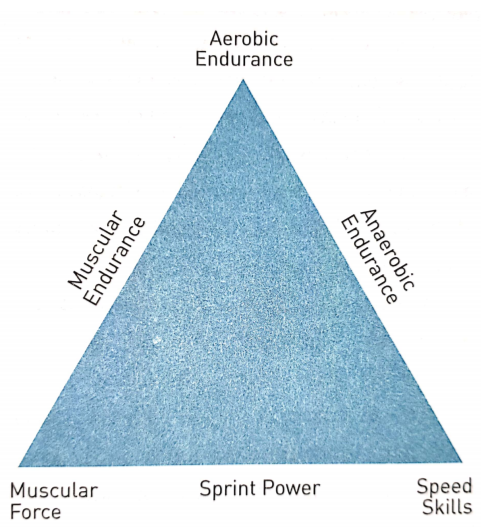
6 categories of workout. Each related to one of the physiological factors.
Basic abilities
They must be well established before moving on the other ones. They are the most important because they are the platform on which race fitness is built.
- Aerobic Endurance (AeE):
- Ability to keep going for a very long time at a low intensity
- Long stead workouts (Zone 2)
- Measured weekly using efficiency factor
- Muscular Force (MF):
- Ability to overcome resistance (water, air, gravity)
- Muscular system, in particular primary movers muscles for each sport.
- Closely related to economy
- Trained with short repetitions at high intensity
- Speed Skills (SS):
- Ability to make the movement of the sport in an efficient way
- Ability to move arms and legs skilfully at high cadences
- Taught and improved with drills, fast repeats of short duration, and sport-specific exercises such as plyometrics. (Short duration, high frequency training is the best way to master a new skill)
Advanced abilities
Shift to advanced abilities in the second part of the season. They are the key to high performance racing. They have a lot to do with how fast you are and how long you can sustain high input.
- Muscular Endurance (ME):
- Ability that ultimately determines how fast you are in a triathlon
- Ability to go on at a moderately high effort for a moderately long time
- Long intervals (6 - 12min) with short recoveries or long (20 - 60min) steady workouts at or just below AnT (Zone 3 - 4)
- Anaerobic Endurance (AnE):
- Single best workout to improve aerobic capacity
- Take sparingly with great caution, it's hard medicine, not candy. You need to do theses workouts, but be prudent.
- A few seconds to a few minutes with intensity (Zone 5) and equal to slightly shorter recovery.
- Sprint Power (SP):
- Least important in triathlon
- Very short intervals (less than 20s) at max intensity with long recovery (several minutes)
Determining ability limiters
- A limiter is a goal-specific weakness. Not good in hills is a weakness, but if the goal race is flat, then it's not a limiter.
- Fill the online forms for each sport (swim, bike, run) to determine your basic abilities and weaknesses
- From your basic abilities, determine your probable weaknesses on advanced abilities based on the triangle above
- Other limiters can include training inconsistency, poor nutrition, poor training environment, not enough time to train, insufficient sleep, …
Abilities and training
- Limiters examples:
- Aerobic endurance is a limiter for ironman, but not for sprint
- Hilly race: muscular force is a limiter but not if the course is flat
- Base ability weakness implies advanced ability weakness for related abilities
- In order to train purposefully, you need to know both your weaknesses and the demands of the race for which you are training.